For industrial applications involving rare earth powders, efficient and reliable material handling is crucial. The pneumatic conveying system, specifically designed for rare earth powder transport, offers a solution that combines precision, safety, and operational efficiency. This article explores the operation process and working principle of such systems, highlighting the key components, operational steps, and the technological advancements that make them indispensable in modern material processing industries.

Company Information and Background
HeadPowder, a leading engineering firm based in Shandong, China, specializes in the design, manufacturing, and implementation of advanced material handling systems. With a strong commitment to innovation and customer satisfaction, the company has established itself as a trusted partner for industries requiring high-performance pneumatic conveying solutions. The headquarters of Shandong HeadPowder Engineering Co., Ltd. is located in Shandong, China, where the company's research and development teams continuously strive to enhance the capabilities of their systems to meet evolving industry demands.
Overview of Rare Earth Powder Pneumatic Conveying Systems
Rare earth powders, due to their unique chemical and physical properties, require specialized handling to prevent contamination, degradation, or loss of material integrity. Pneumatic conveying systems provide an ideal method for transporting these powders over short to medium distances, offering advantages such as minimal product degradation, reduced labor costs, and enhanced safety compared to traditional methods like manual handling or mechanical conveying. The systems are designed to handle fine powders with high precision, ensuring that the material remains in its original state throughout the transport process.

Key Components of the Pneumatic Conveying System
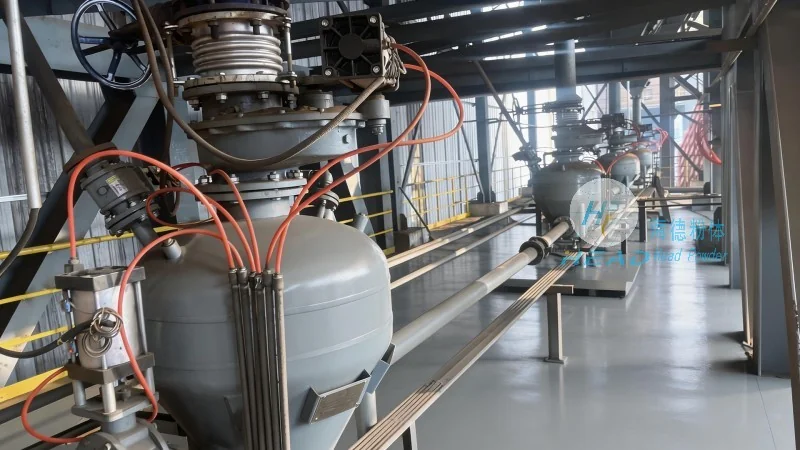
The rare earth powder pneumatic conveying system consists of several critical components that work in tandem to achieve efficient material transport. These components include the material hopper, which stores the rare earth powder; the air compressor or blower, which generates the necessary air pressure to move the material; the conveying line, typically made of stainless steel or other corrosion-resistant materials to prevent contamination; and the control system, which regulates the flow of air and material. Additionally, the system may include filters to capture any fine particles and prevent them from escaping into the environment, as well as pressure relief valves to ensure safe operation under varying conditions.
Operation Process of the Pneumatic Conveying System
The operation of the rare earth powder pneumatic conveying system follows a systematic process that ensures smooth and continuous material transport. The process begins with the loading of the rare earth powder into the material hopper. The hopper is equipped with a feeding mechanism, such as a rotary valve or a screw feeder, which controls the flow of powder into the conveying line. Simultaneously, the air compressor starts and generates a high-pressure air stream. The air stream is then introduced into the conveying line, creating a flow that pulls the powder particles along with it. As the powder moves through the line, it is transported to the destination point, such as a storage silo or a processing unit. The control system monitors the pressure and flow rates, adjusting the air supply as needed to maintain optimal transport conditions. The entire process is automated, minimizing the need for manual intervention and ensuring consistent performance.
Working Principle of the Pneumatic Conveying System
The working principle of the rare earth powder pneumatic conveying system is based on the principles of fluid dynamics and particle transport. The system operates by creating a pressure differential between the inlet and outlet of the conveying line. The air compressor provides the necessary pressure to push the air through the line, while the powder particles are entrained by the air stream. The velocity of the air is maintained at a level that ensures the powder particles are fully suspended and transported without settling or clogging the line. The system utilizes either positive pressure or negative pressure (or a combination of both) to achieve the desired transport. Positive pressure systems push the material through the line using compressed air, while negative pressure systems draw the material into the line using a vacuum. The choice of system depends on the specific application and the distance to be covered.
Advantages of Using Pneumatic Conveying for Rare Earth Powders
Implementing a pneumatic conveying system for rare earth powders offers several advantages that make it a preferred choice for many industries. Firstly, the system provides a closed-loop transport, which prevents contamination from external sources and minimizes dust emissions, ensuring compliance with environmental regulations. Secondly, the system reduces the risk of product degradation due to exposure to air or moisture, as the material is contained within the conveying line. Thirdly, the automated nature of the system reduces labor costs and improves operational efficiency, allowing for continuous production without interruptions. Additionally, the system can handle a wide range of powder types and sizes, making it versatile for various applications. Finally, the system is relatively easy to install and maintain, with minimal downtime required for servicing.

Applications and Industries Utilizing Rare Earth Powder Pneumatic Conveying Systems
The rare earth powder pneumatic conveying systems are widely used in various industries that rely on rare earth materials for their products. These industries include electronics, where rare earth elements are used in magnets and batteries; automotive, where they are used in catalytic converters and fuel systems; and renewable energy, where they are used in wind turbine components and solar panels. The systems are also utilized in the chemical and metallurgical industries for the transport of rare earth compounds and alloys. The versatility of the system makes it suitable for both small-scale and large-scale production facilities, catering to the diverse needs of the modern manufacturing sector.
Conclusion and Future Developments
In conclusion, the rare earth powder pneumatic conveying system is a sophisticated and efficient solution for the transport of rare earth materials. The system's operation process, which involves precise control of air flow and material feeding, combined with its working principle based on fluid dynamics, ensures reliable and consistent performance. With the continuous advancements in technology, such as the integration of smart sensors and automated control systems, the systems are becoming even more efficient and user-friendly. As industries continue to rely on rare earth materials for their products, the demand for advanced material handling solutions like pneumatic conveying systems will only increase. HeadPowder, with its expertise and commitment to innovation, remains at the forefront of providing high-quality systems that meet the evolving needs of the industry.




