HeadPowder, a leading engineering company based in Shandong, China, specializes in the design, manufacturing, and installation of advanced air-pneumatic conveying systems tailored for handling sponge sand materials. This article provides a detailed overview of the operational process and underlying working principles of such systems, highlighting their efficiency, reliability, and adaptability in material handling applications.

Introduction to Air-Pneumatic Conveying Systems for Sponge Sand
At HeadPowder, our air-pneumatic conveying lines are engineered to efficiently transport sponge sand, a lightweight and porous material commonly used in construction, foundry, and other industrial sectors. These systems utilize a combination of air pressure and vacuum to move materials through pipelines without the need for mechanical components like belts or buckets. The design ensures minimal material degradation, low maintenance requirements, and high throughput, making them ideal for both short and long-distance material transport.
Key Components of the Conveying Line
The air-pneumatic conveying line for sponge sand typically consists of several critical components that work in tandem to ensure smooth operation. These include the material feed hopper, which holds the sponge sand and controls the flow rate; the air compressor or vacuum pump, which generates the necessary pressure or suction to move the material; the pipeline system, which transports the material from the source to the destination; and the discharge unit, which releases the material at the receiving end. Each component is carefully selected and integrated to optimize performance and durability.

Operation Process: Step-by-Step
The operation of the air-pneumatic conveying line for sponge sand follows a systematic process that ensures consistent and reliable material transport. The process begins with the material being fed into the hopper at a controlled rate. Simultaneously, the air compressor generates compressed air, which is introduced into the pipeline. As the air flows through the pipeline, it creates a low-pressure zone that draws the sponge sand particles into the air stream. The mixture of air and material travels through the pipeline to the discharge point, where the material is separated from the air and collected in the receiving container. The air is then filtered and returned to the system, completing the cycle.
Working Principle: How It Works
The core working principle of the air-pneumatic conveying line relies on the interaction between air and the sponge sand particles. When compressed air is introduced into the pipeline, it creates a high-velocity flow that entrains the material particles. The air flow velocity is typically maintained above the minimum fluidization velocity of the sponge sand, ensuring that the particles remain suspended and transported efficiently. The system can operate in either positive pressure (where compressed air pushes the material) or negative pressure (where vacuum pulls the material), depending on the application requirements. This flexibility allows for adaptation to various distances and layouts, from short, horizontal runs to longer, multi-level systems.
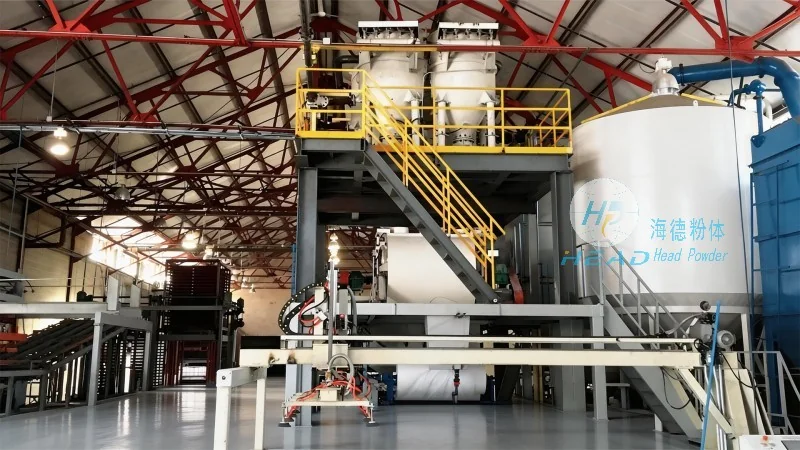
Advantages and Applications
HeadPowder's air-pneumatic conveying lines for sponge sand offer several advantages over traditional material handling methods. These include reduced labor costs due to automated operation, minimal material degradation due to the absence of mechanical components, and lower energy consumption compared to other systems. The systems are widely used in industries such as construction for transporting sand to job sites, foundries for feeding raw materials into molding processes, and recycling facilities for handling reclaimed sand. Their adaptability to different material types and operational conditions makes them a versatile solution for various industrial needs.
Maintenance and Reliability
Ensuring the long-term performance and reliability of the air-pneumatic conveying line is crucial. HeadPowder provides comprehensive maintenance services and recommends regular inspections of key components, such as the air compressor, pipeline seals, and filter systems. Proper maintenance, including cleaning of filters and checking for air leaks, helps prevent system downtime and extends the lifespan of the equipment. The robust design of the conveying line, with its durable materials and efficient air flow management, contributes to high operational reliability, even in demanding industrial environments.




