HeadPowder, a leading manufacturer based in Shandong, China, specializes in the design and production of advanced gas-pneumatic conveyors for handling precipitated barium sulfate powder. This equipment is engineered to efficiently transport fine powders over short to medium distances, ensuring minimal product degradation and consistent performance. The following sections detail the operational process and underlying principles of such a system.

Overview of the Gas-Pneumatic Conveyor System
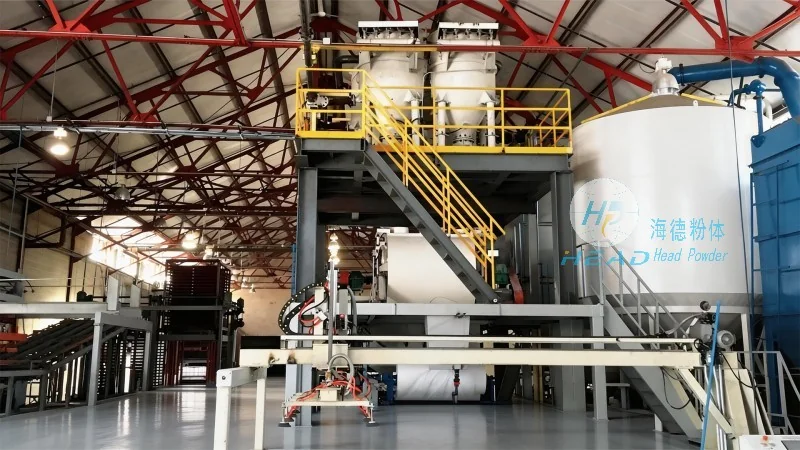
The gas-pneumatic conveyor for precipitated barium sulfate powder is a closed-loop system that utilizes compressed air to move the powder through a network of pipes. The system is typically composed of several key components, including a hopper for material storage, a rotary valve or feeder to control the flow rate, a series of straight and curved pipes, and a discharge unit. Each component plays a critical role in maintaining the integrity of the powder and the efficiency of the conveying process.
Step-by-Step Operational Process
The operation of the conveyor begins with the loading of precipitated barium sulfate powder into the hopper. The powder is then fed into the system via a rotary valve, which regulates the flow rate to match the required conveying capacity. Compressed air, supplied by an air compressor, is introduced into the pipeline at a controlled pressure and flow rate. As the air flows through the pipes, it creates a low-pressure zone that draws the powder particles into the air stream, forming a dense gas-solid mixture. This mixture travels through the pipeline to the discharge point, where the air is separated from the powder, typically using a cyclone separator or a filter. The separated powder is then collected in a receiving bin, while the air is either vented to the atmosphere or recirculated back to the system for energy efficiency.
Working Principle of the Gas-Pneumatic Conveying Mechanism
The core principle of gas-pneumatic conveying is the suspension and transport of solid particles by a moving gas stream. In the case of precipitated barium sulfate powder, the powder particles are entrained by the compressed air, which overcomes the gravitational force acting on the particles. The air velocity within the pipeline must be sufficient to maintain the particles in a suspended state, preventing them from settling and clogging the system. The pressure drop along the pipeline is a critical factor, as it determines the energy required to move the powder and the overall system efficiency. Proper design of the pipeline diameter, length, and curvature is essential to minimize pressure losses and ensure smooth operation.

Key Features and Benefits of the Conveyor
HeadPowder's gas-pneumatic conveyor for precipitated barium sulfate powder offers several advantages over traditional bulk material handling methods. The closed system design prevents dust emissions and contamination, making it suitable for applications where product purity is paramount. The equipment is also compact and easy to install, requiring minimal space and maintenance. Additionally, the system can be integrated with other processing equipment, such as mixing or packaging units, to form a complete production line. The energy efficiency of the system, particularly when using air recirculation, reduces operational costs and environmental impact.
Application and Industry Use Cases
This type of gas-pneumatic conveyor is widely used in industries that handle fine powders, including chemical manufacturing, pharmaceuticals, and food processing. In the case of precipitated barium sulfate, it is commonly used as a filler or pigment in coatings, plastics, and rubber products. The conveyor's ability to handle abrasive and moisture-sensitive powders makes it ideal for applications where product quality and consistency are critical. HeadPowder's system has been successfully implemented in various production facilities, demonstrating its reliability and performance in real-world scenarios.




