Dolomite powder pneumatic conveying lines are critical systems in industrial material handling, designed to efficiently transport dolomite powder from source to destination. This article explores the fundamental principles behind these systems and highlights key working scene characteristics that define their application in various industrial settings.
Company Overview
As a leading provider in the field, Shandong HeadPowder Engineering Co., Ltd. specializes in the design, manufacturing, and installation of advanced pneumatic conveying solutions. With a focus on durability and efficiency, their systems are engineered to meet the specific demands of dolomite powder handling, ensuring reliable performance in demanding environments.
Product Introduction
The core of a dolomite powder pneumatic conveying line is its ability to transport fine powders through a pressurized or vacuum system. These lines typically consist of several key components, including a material feeder, a conveying pipeline, a control system, and a discharge unit. The system operates by creating a flow of air or gas that carries the dolomite powder particles through the pipeline, ensuring consistent and controlled movement.

Principle of Operation
The principle of operation involves the use of air or gas as the conveying medium. In a typical system, the dolomite powder is fed into the pipeline at a controlled rate, and the air is introduced to create a flow that lifts and transports the powder. The velocity of the air is crucial, as it must be sufficient to overcome the gravitational forces acting on the powder particles while maintaining a stable flow. This ensures that the powder is conveyed without clogging or degradation.
Working Scene Characteristics
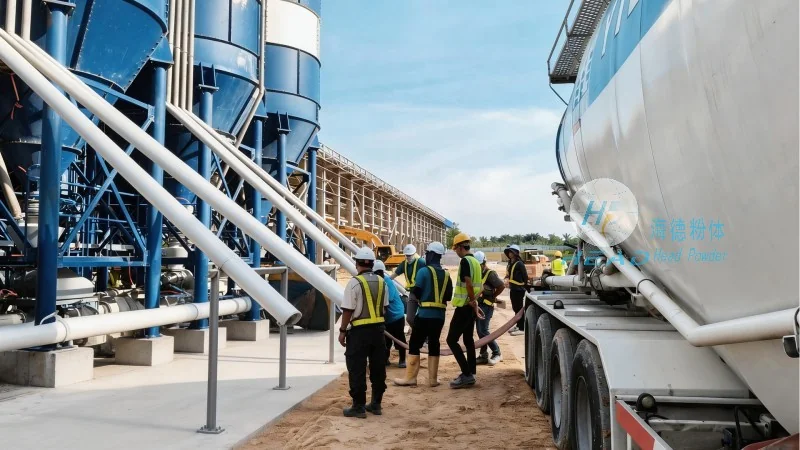
Working scene characteristics of dolomite powder pneumatic conveying lines vary based on the specific industrial application. For example, in cement production, these systems are used to transport dolomite as a raw material, requiring high capacity and reliability to support continuous production processes. In mining operations, the lines may need to handle larger quantities of dolomite from storage to processing facilities, emphasizing the importance of robust construction and material compatibility.
System Advantages
These conveying lines offer several advantages over traditional methods, such as reduced dust generation, improved safety, and the ability to transport materials over long distances without the need for intermediate storage. The closed system design also minimizes environmental impact, making them suitable for applications where dust control is critical.

Application Examples
In industrial settings, dolomite powder pneumatic conveying lines are commonly used in the chemical, pharmaceutical, and food processing industries, where the handling of fine powders requires precision and hygiene. The systems are also utilized in the production of building materials, where dolomite is used as an additive to enhance the properties of concrete and other composites.
Conclusion
Overall, dolomite powder pneumatic conveying lines are essential equipment for efficient and safe material handling in various industrial sectors. By understanding the principles of operation and the specific characteristics of working scenes, industries can select and implement the most suitable systems to meet their operational needs and enhance productivity.




